

Post Drum Lift to Tablet Press
Case Study: Drum-to-Tablet Press Feeding Systems

Industry Context
In pharmaceutical and nutraceutical manufacturing, tablet presses demand a stable, continuous, and predictable powder feed. Variability in material delivery—especially when feeding directly from drums—can lead to press interruptions, inconsistent tablet weight, and increased operator intervention.
Post Material Handling has designed, built, and installed multiple Drum-to-Tablet Press feeding systems to address these challenges, providing reliable material transfer from drums directly into tablet press feed systems.

The Challenge
Facilities feeding tablet presses directly from drums frequently encounter:
-
Inconsistent material flow due to powder compaction or bridging
-
Manual drum handling that introduces ergonomic and safety risks
-
Dust generation during drum dumping and transfer
-
Difficulty matching upstream feed rates to tablet press demand
-
Increased downtime caused by feeder starvation or surging
These issues directly impact tablet quality, production throughput, and operator safety.

The Solution: Drum-to-Tablet Press System
The Post Material Handling Drum-to-Tablet Press system is engineered to provide controlled, repeatable material transfer from drums into tablet presses. Rather than relying on manual dumping, the system uses mechanical handling and metered feeding to deliver powder consistently to the press.
Key elements of the system include:
-
Secure drum handling and positioning
Drums are mechanically restrained and discharged in a controlled manner, reducing variability and operator effort. -
Metered feeding into the tablet press
Conveying or feeding devices regulate material flow to match press requirements, minimizing surging or starvation. -
Dust-tight transfer interfaces
Sealed connections reduce material loss and operator exposure during transfer. -
Integrated controls
Feed behavior is coordinated with tablet press operation to maintain consistent material availability.
These systems have been implemented in production environments where tablet weight consistency and uptime are critical.

Integration with Tablet Press Operations
Drum-to-Tablet Press systems are typically integrated directly upstream of the tablet press feeder. In a typical configuration:
-
Material is discharged from a drum in a controlled manner
-
The powder is conveyed or metered toward the tablet press
-
Feed rate is synchronized with press speed
-
Operators monitor and adjust parameters from a centralized interface
This integration transforms a traditionally manual operation into a predictable, automated feeding process.

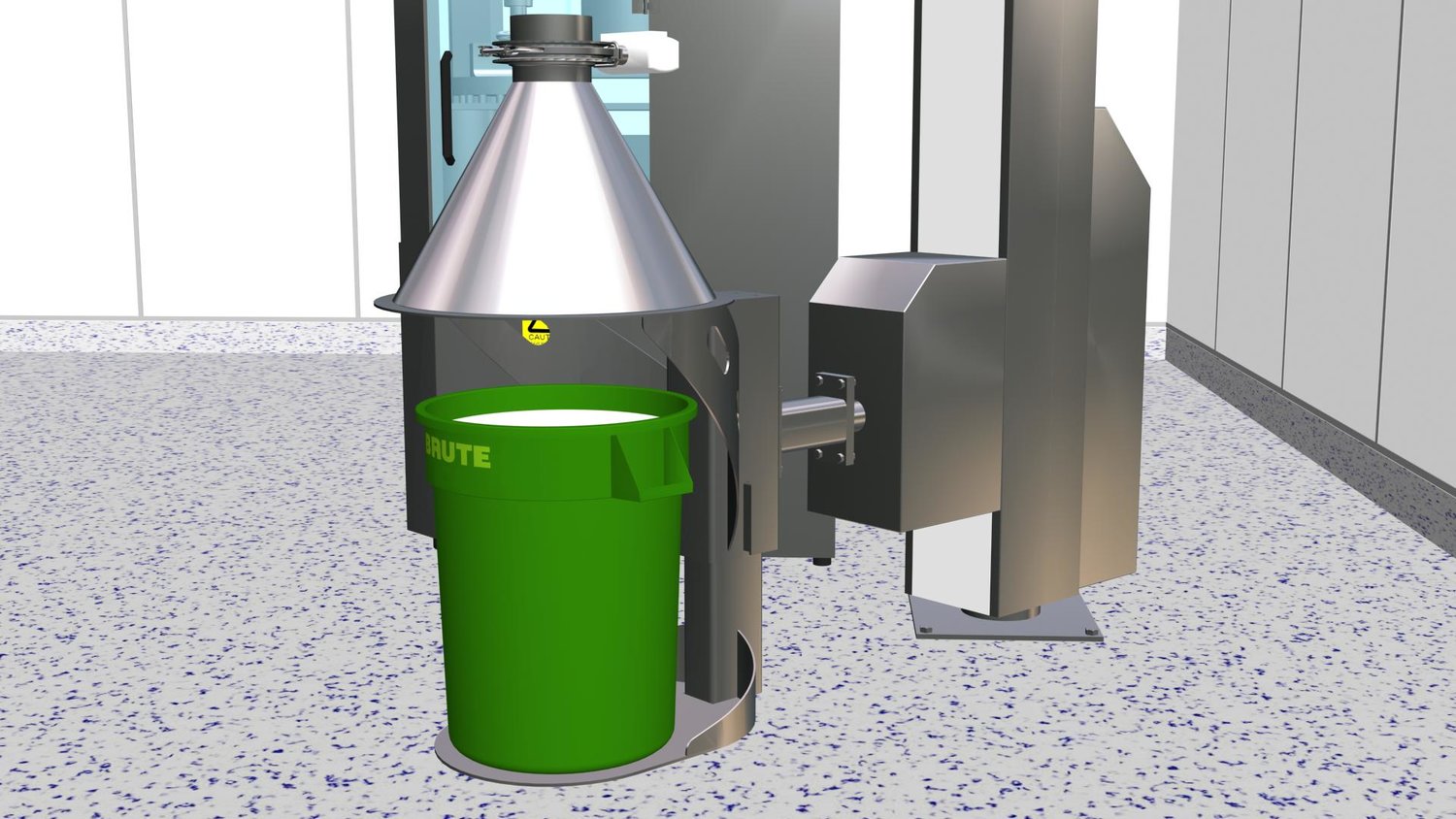
Post Lift discharging through Y-Chute into a tablet press
Results Observed in the Field
Across multiple installations, customers experience consistent operational benefits:
-
Improved feed stability, supporting uniform tablet weight
-
Reduced operator intervention, minimizing disruptions
-
Lower dust exposure during material transfer
-
Improved ergonomics and safety by eliminating manual drum dumping
-
Higher overall equipment effectiveness (OEE) at the tablet press
For many facilities, the system becomes a critical interface between raw material handling and tablet production.
Typical Applications
Drum-to-Tablet Press systems are used for:
-
Pharmaceutical APIs and excipients
-
Nutraceutical and supplement powders
-
Blended tablet formulations
-
Powders with challenging flow characteristics
Systems can be configured for sanitary environments, wash-down requirements, or hazardous area classifications as needed.
Summary
With multiple systems built and installed, the Drum-to-Tablet Press feeding system is a proven solution for improving reliability, safety, and consistency in tablet press operations. By replacing manual drum dumping with controlled mechanical feeding, the system enhances product quality while reducing downtime and operator risk.
Image Gallery


Repurposing
Post Material Handling Post Lifts may be bought back for repurposing when its original design function is no longer applicable. Repurposing was one of the major design criteria when the Post Lifts were originally conceived.
Repurposing reduces waste, adds reselling value and is the responsible means to recycle equipment.

Virtual Reality Demo
Post Virtual Reality develops proposals and building layouts using state of the art Virtual Reality visualizations.
We will build your layout in 3D and make it available to you using a standard web browser. The same VR environment can be viewed in browser on your desktop or laptop computer, a head mounted display and cell phone.
Post Virtual Reality converts CAD data into 3D presentations. If you do not have 3D CAD data, we will model your equipment and layouts for you.

Here’s What Our Client’s Are Saying
“We have teamed up with Post for over 9 years on several successful projects. Pat and his team are very knowledgeable and are able to supply solutions that integrate perfect with our machines.
Not only are their material handling solutions very well manufactured, I am especially grateful for the attention to detail and automation expertise at Post. They are problem solvers and a terrific resource for all material handling projects.”